
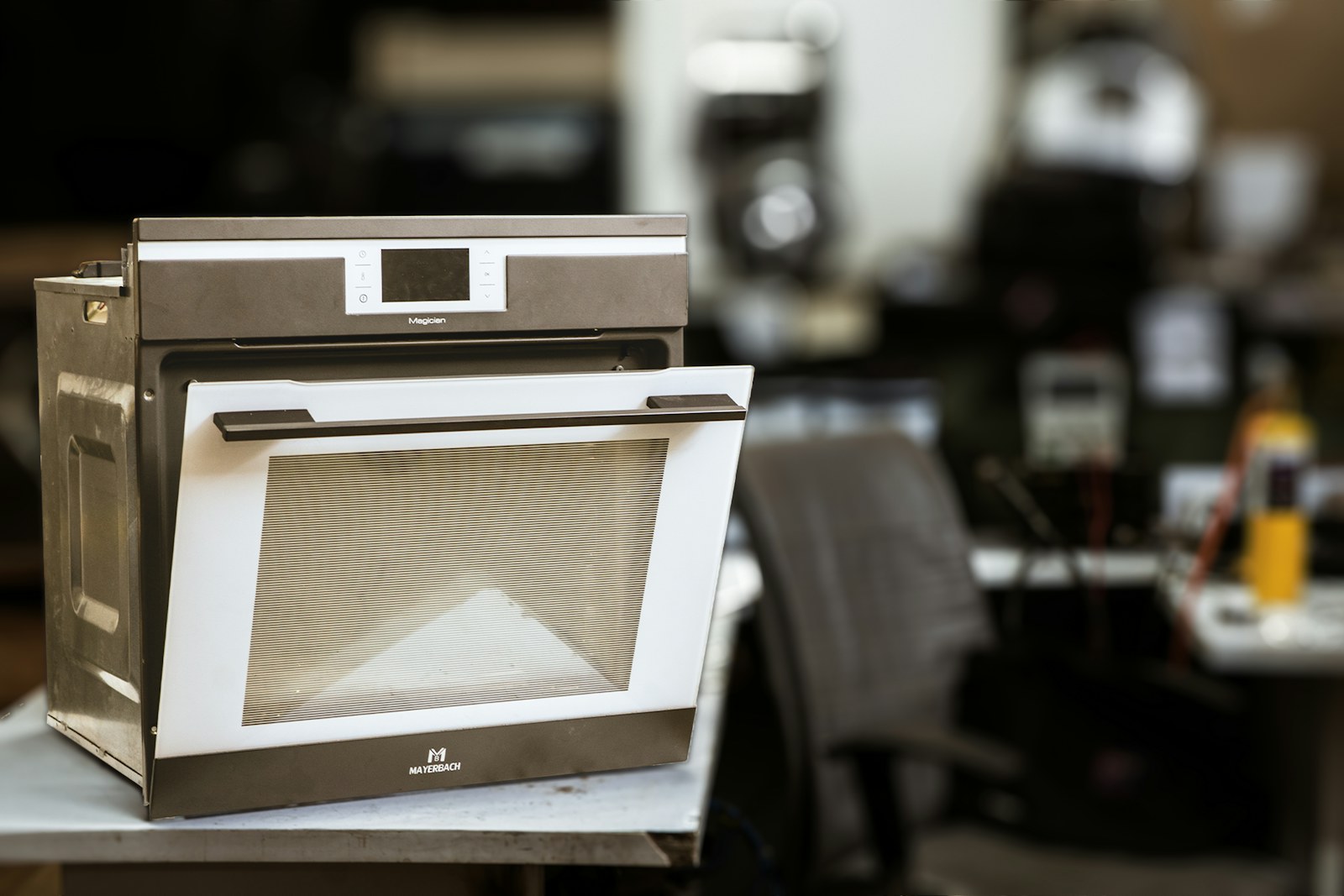
If your oven fan isn’t spinning, has started grinding or rattling, or keeps running after you switch the oven off, the cause is usually one of three things: a setting that doesn’t use the fan, a worn or seized fan motor, or a fault in the parts that power it. A few safe checks from the front of the oven will usually narrow it down. Anything behind the panels is a job for a technician.
The two fans in most built-in ovens
Most fan-forced ovens have a convection fan at the back of the oven cavity, behind a slotted metal cover. It moves hot air around the oven so food cooks evenly, and in a fan-forced oven it usually sits inside a round element. Our guide to fan-forced elements explains how the element and fan work together.
Many built-in ovens also have a cooling fan, hidden above the oven cavity. It blows air out through a vent near the top or bottom of the door to keep the controls and the surrounding cabinetry cool. On many models this fan keeps running for a while after you switch the oven off, until the oven has cooled down. That is normal, not a fault. Check your appliance manual for how yours behaves.
Signs the oven fan has a problem
- The oven heats on conventional (top and bottom) settings but cooks slowly or unevenly on fan settings.
- With the oven light on and a fan setting selected, you can’t see the blade turning through the door glass.
- A grinding, scraping, rattling or loud humming noise that wasn’t there before.
- The fan starts slowly, stutters, or only turns some of the time.
- A burning smell, or the oven tripping the power.
If the fan is turning but the oven isn’t getting hot, the element is a more likely suspect than the fan. Our article on an oven not heating up covers that problem.
Common causes of an oven fan not working
A setting that doesn’t use the fan. Conventional bake, grill and some other functions work differently, and on some of them the convection fan doesn’t run at all. Check the function symbols in your manual before assuming a fault.
The door switch. Some ovens pause the convection fan when the door is opened, so hot air isn’t blown into the kitchen. If the fan stops only while the door is open, that’s often by design.
A worn or seized fan motor. The bearings inside the motor wear over time. Early on this usually shows up as noise; eventually the motor can slow down or stop altogether. Heat and grease build-up speed this up.
Something touching the fan blade. A piece of foil, a tray pushed too far back or a fan cover that has been knocked out of place can stop the blade or make it scrape.
Wiring or control faults. A failed connection, the function selector switch or the electronic control board can stop power reaching the fan, even when the motor itself is fine.
A failed cooling fan. If the cooling fan stops, the controls and cabinetry can run hotter than they should, and some ovens may cut out to protect themselves.
Safe checks you can do yourself
These checks don’t involve removing any covers or panels.
- Check the oven has power. The clock or display should be on, the isolation switch (a wall switch for the oven, often nearby or in a cupboard) should be on, and the circuit breaker or safety switch at the switchboard shouldn’t have tripped.
- Make sure the clock is set and no timer, child lock or delayed start is active. Some ovens won’t start a cooking function until the clock has been set.
- Choose a fan setting, turn the oven light on and close the door. Look through the glass to see whether the blade behind the rear cover is turning.
- Close the door firmly. If the fan only runs with the door shut, the door switch is doing its job.
- With the oven off and cool, check that nothing is sitting against the rear fan cover, such as foil or a tray pushed right to the back.
- Listen carefully. Note whether the noise is constant or only at start-up, and whether it comes from the back of the oven or from above the door. That helps the technician.
- Write down the make and model from the oven’s rating plate. It’s often on the edge of the door frame or the oven front; check your manual if you can’t find it.
When to stop and call a technician
Stop using the oven and switch it off at the isolation switch if it trips the power, smells of burning, or gives you a tingle or shock when you touch it. The NSW Government’s electrical safety advice is never to touch an appliance that causes a tingle or shock until it has been repaired, and notes that by law electrical installation work must be done by a licensed electrician.
Don’t remove the rear fan cover or the back panel, and don’t try to free a seized motor yourself. The fan blade, motor and wiring sit close to live connections and the element, and the repair needs the oven isolated and the right replacement part for your model.
Repair or replace?
A fan motor is a replaceable part, so a noisy or stopped fan is usually a repair rather than a reason to replace the whole oven. It’s worth weighing up the oven’s age and general condition, whether other parts are also failing (such as elements, the thermostat or the door seal), and whether parts are still available for your model.
The technician will confirm on the day which part has failed, and any part is quoted before it’s fitted. You can see the oven parts we commonly replace on our oven and stove repairs page.
Landlords and property managers
When a tenant reports a “noisy oven”, they’re often describing a fan motor on its way out. It’s worth acting early, because a worn motor can stop completely, and a failed cooling fan can lead to other faults. Ask the tenant for the make and model and a short description of the noise or symptom.
Real estate agencies have their own way to book a repair for a tenanted property; see our real estate and strata page. The technician calls whoever is at the property.
Oven Fan FAQs
Is it normal for my oven fan to keep running after I turn the oven off?
Often, yes. That is usually the cooling fan, which keeps running until the oven has cooled. If it never stops, or runs while the oven is cold, have it checked.
Can I still use my oven if the fan isn’t working?
You may still be able to cook on conventional settings, but cooking will be slower and less even, and if the cooling fan has failed the controls can overheat. If there’s a burning smell, the power trips, or the noise keeps getting worse, stop using it.
Why does my oven fan stop when I open the door?
Many ovens are designed to pause the convection fan while the door is open. If it starts again when you close the door, that’s normal.
Why is my oven fan so loud?
A new grinding, scraping or rattling noise usually points to worn motor bearings or something touching the blade. Check that nothing is against the rear cover. If the noise continues, the motor may need replacing.
If your oven fan has stopped or is getting louder, call us on (02) 9067 3131 or send a repair enquiry and we’ll call you back to arrange a time. We come to you.